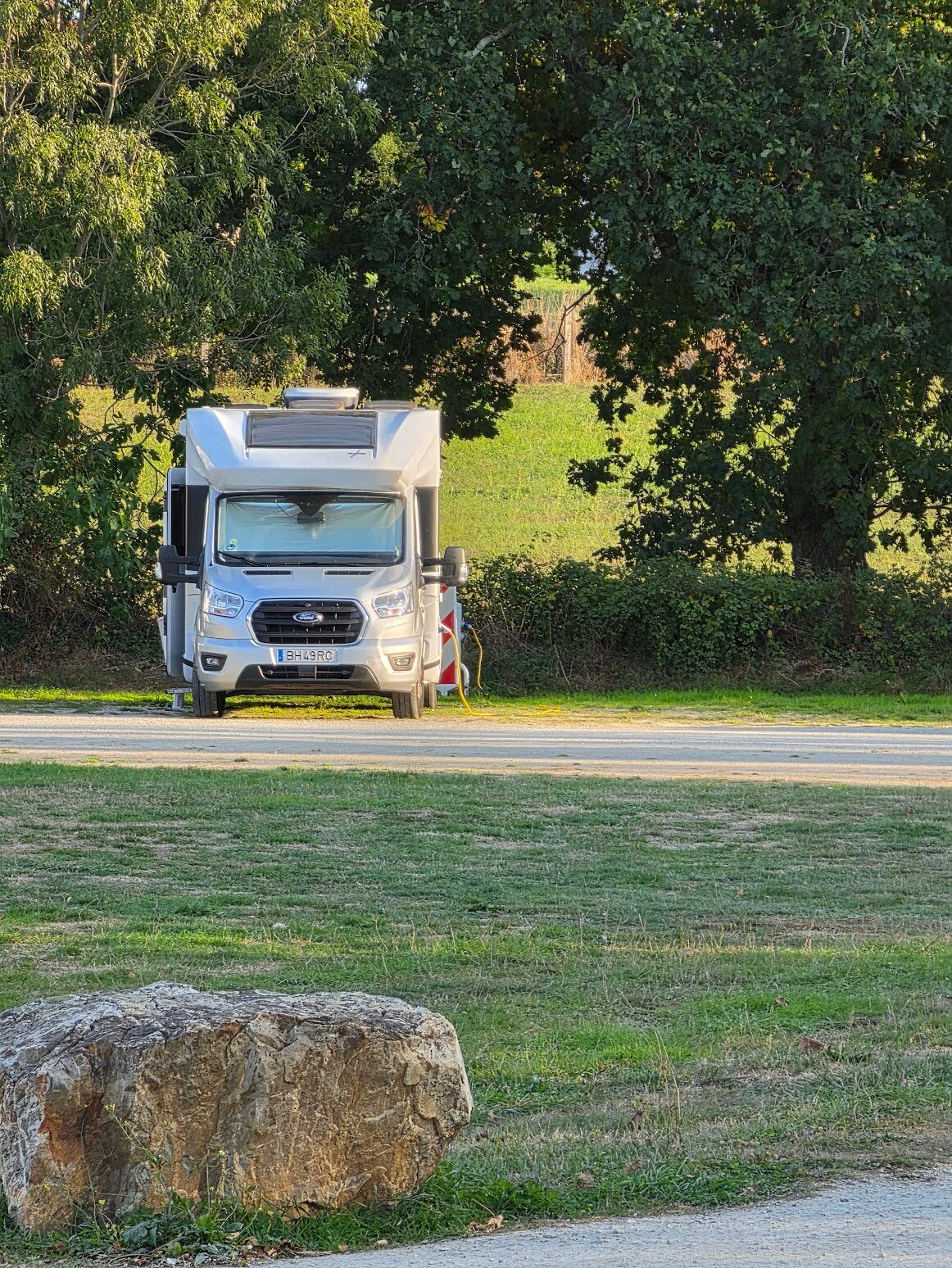
"A motorhome with one foot planted does not drive anywhere."
Brioux-sur-Boutonne, Deux-Sèvres, France.
June. Morning. The Benimar’s hydraulic jacks—four of them, one at each corner—are supposed to level the house wherever the day ends.
Three retracted. The fourth did not.
The front-right jack was stuck in the ground. The motorhome was pinned to a spot of France like a tent pegged in a storm.
The Problem
The jack had form. Weeks earlier, it had started throwing false fault signals from a corroded cable. Roque, the crew’s mechanic, had diagnosed it remotely from the symptoms I described. A professional shop had repaired it. The repair had not held.
This morning, it had arguably made things worse.
The Attempts
I tried everything I knew. Manual operation recovered the other three. The fourth would not budge.
- Method 1: Control panel override. No response.
- Method 2: Crank handle. The jack groaned, then stalled.
- Method 3: Rocking the motorhome. The jack held firm.
- Method 4: A well-placed kick (desperation, not engineering). Nothing.
The morning had changed shape.
The Crew’s Turn
Roque did what the crew does best: he produced the phone numbers of local motorhome specialists, correct and current.
Pause here.
An AI can find every mechanic in the département in seconds. It cannot make a Frenchman pick up the telephone. The technology had done its part perfectly. The morning was still broken.
The Human Layer
Le fixed it. Not with code, not with tools—with people.
"Call the local police," she said.
We did. The police spoke French. We spoke English and Portuguese. The call went nowhere.
So we did the oldest thing there is: we flagged down a stranger passing by and asked for help.
He gave us his morning.
- He spoke to the police.
- He produced the number of a mechanic the phone lists had missed.
- He called the mechanic himself.
- He talked him through the problem, one neighbor to another, in the language the day required.
The Fix
The mechanic arrived. Lifted the wheel. Reseated the jack. Packed his tools.
He wanted nothing for it.
I insisted. The way I insist. Forty euros. The house had four working corners again.
The Epilogue (and the Real Lesson)
The jack system, apparently offended by its rescue, began sounding an alarm. A relentless, high-pitched shriek. The documentation offered no way to silence it. No switch. No setting. No procedure.
Roque went back to the papers—but not the pages an owner reads. He read the installation manual. The wiring. The system.
The control panel, he found, draws its power through a cable connected at the back. Disconnect the cable, and the panel sleeps. The alarm with it.
That is written in no manual as a remedy. Roque derived it—from the diagram, the way I’ve derived things my whole life: by understanding the system instead of obeying the instructions.
The Hands That Fixed the Day
Count them:
- An AI that produced every phone number—and, later, the one cable that mattered.
- A wife who thought of the police when the technology ran out of road.
- A stranger who gave his morning and his French to people he’d never met.
- A mechanic who lifted a wheel, solved it in ten minutes, and wanted nothing.
- A captain who paid him anyway.
The crew did what the crew could do. The rest was done by human beings on a village road, being kind to each other across a language neither side fully shared.
The Philosophy
The household got its motorhome back through the arrangement this book keeps finding at the bottom of everything:
The technology and the people, each doing the part only they could do—and the gap between them closed by a stranger who stopped.
Written from the road, with Jolie on the bench and the jack system finally silent.